
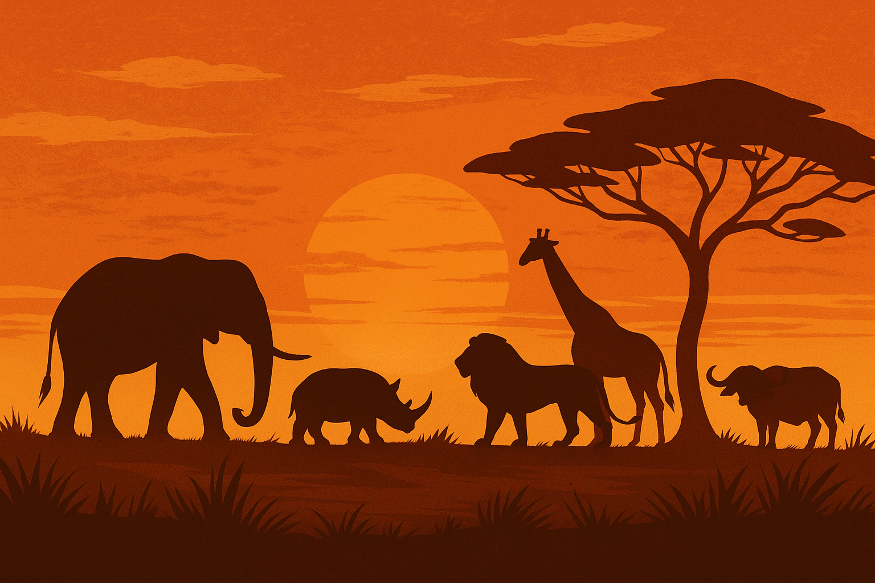
Big Five silhouette
East Africa’s savannas and forests host the full cast of wildlife stars known as the Big Five – the African lion, leopard, elephant, buffalo and rhinoceros. Once considered the most dangerous animals to hunt on foot, these species earned their collective name in the late 1800s and early 1900s. Today the Big Five are celebrated icons of African biodiversity and feature at the top of every safari wish‑list.
What Makes Them the “Big Five”?
The term Big Five has nothing to do with size. Colonial hunters and trappers coined it to describe the five most challenging and dangerous animals to hunt on foot – lions, leopards, elephants, rhinoceroses and Cape buffaloes. Modern safari goers pursue these animals only with cameras, but the name endures as a badge of honor for any destination that can deliver sightings of all five.
African Lion – King of the Savanna
African lions are powerful predators and the second‑largest cats on Earth. Their brownish‑yellow coats provide camouflage in tall grass and their sharp claws and jaws can bring down large prey. Lions live in social groups called prides and communicate over long distances with roars audible up to 8 km. Although once widespread across Africa, the Middle East and parts of Europe, their range is now limited to protected areas in sub‑Saharan Africa and their numbers have crashed from about 200 000 a century ago to roughly 23 000.
Where to See Lions in East Africa
- Maasai Mara National Reserve (Kenya) – home to an estimated 850–900 lions across numerous prides. The open grasslands offer excellent visibility for watching hunts, social interactions and territorial disputes.
- Amboseli National Park (Kenya) – famous for the dark‑maned lions that roam beneath Mount Kilimanjaro.
- Tsavo East & West (Kenya) – Kenya’s largest lion population lives here; the lions have smaller manes adapted to the hotter climate.
- Serengeti National Park (Tanzania) – believed to host Africa’s largest lion population, commonly sighted on game drives.
- Ngorongoro Crater (Tanzania) – the caldera supports the densest lion population in Africa.
Viewing tip: Lions are most active during early morning (6 – 9 AM) and late afternoon (4 – 6:30 PM). During midday they rest in the shade; patient observers may witness pride dynamics and grooming behaviors.
African Leopard – Master of Stealth
Leopards are the most elusive of the Big Five because they are solitary and nocturnal, resting during the day in trees or dense bush. These cats are remarkably strong for their size, able to drag heavy prey up trees to keep it from scavengers. They can sprint at 36 mph and leap nearly 20 ft across. Each leopard has a unique rosette pattern on its coat, like human fingerprints.
Where to See Leopards in East Africa
- Maasai Mara’s riverine forests (Kenya) – along the Mara and Talek rivers; dense vegetation and tree cover provide ideal habitat.
- Samburu National Reserve (Kenya) – sometimes called Kenya’s leopard capital; diverse terrain and habituated individuals increase sighting odds.
- Aberdare National Park (Kenya) – offers mountain leopard encounters in montane forests.
- Serengeti National Park (Tanzania) – excellent sightings in the Seronera Valley, where leopards hunt along river courses.
- Ngorongoro Crater (Tanzania) – leopards occur but are harder to spot; sightings require luck and persistence.
Viewing tip: Leopards are most active at dawn and dusk. Watch for alarm calls from baboons or antelope, which often signal a leopard’s presence.
African Elephant – Gentle Giant and Ecosystem Engineer
African elephants are the largest land animals on Earth; individuals can weigh up to 7.5 tonnes and stand three meters tall. They are herbivores that may consume about 500 pounds of plants per day. Elephants are intelligent, with excellent memories and complex social structures; family herds are led by an experienced matriarch. Their trunks are multi‑purpose tools used for drinking, feeding and social communication, and they can even swim using their trunks as snorkels.
Where to See Elephants in East Africa
- Amboseli National Park (Kenya) – iconic views of elephants beneath snow‑capped Mount Kilimanjaro and some of Africa’s largest tuskers.
- Tsavo East & West (Kenya) – protects Kenya’s largest elephant population (~15 000 animals) and is famous for the red‑dust elephants that coat themselves in the rust‑colored soil.
- Maasai Mara National Reserve (Kenya) – substantial herds year‑round, especially when wildebeest and zebra migrate through.
- Samburu National Reserve (Kenya) – desert‑adapted elephants dig for water in dry riverbeds.
- Ngorongoro Crater (Tanzania) – elephants, including large bulls with impressive tusks, are common.
- Serengeti National Park (Tanzania) – elephants roam the open plains; most commonly seen in the northern sector.
- Ruaha & Tarangire National Parks (Tanzania) – host some of the largest elephant populations in Africa; sightings are virtually guaranteed.
Viewing tip: Elephants congregate around permanent water sources during the dry season (June – October), creating spectacular viewing opportunities. They are highly protective of calves, so always observe from a respectful distance.
Rhinoceros – Critically Endangered Icons
The Big Five include both black and white rhinoceroses. White rhinos have a wide mouth suited to grazing, while black rhinos have a pointed upper lip. Rhinos are unpredictable and may charge when threatened; their horns, composed of keratin (the same material as human hair and nails), have unfortunately made them targets of poachers. By the end of 2023, Africa’s rhino population had fallen to around 23 290 animals. The northern white rhino is functionally extinct, with only two females remaining and no males.
Where to See Rhinos in East Africa
- Ngorongoro Crater (Tanzania) – the best place in Tanzania to see rhinos; the crater hosts a sizeable population of black rhinos.
- Serengeti National Park (Tanzania) – a small number of rhinos occurs in the central region, though sightings require luck.
- Lake Nakuru National Park (Kenya) – Kenya’s premier rhino sanctuary with over 70 rhinos (both black and white); sightings are almost guaranteed.
- Ol Pejeta Conservancy (Kenya) – East Africa’s largest black rhino sanctuary, protecting more than 140 black rhinos and the world’s last two northern white rhinos.
- Nairobi National Park (Kenya) – holds a significant black rhino population where rhinos graze against the city skyline.
- Tsavo East National Park (Kenya) – the Ngulia Rhino Sanctuary provides safe habitat for a small but important black rhino population.
Conservation note: Kenya’s rhino population recovered from fewer than 300 individuals in the 1980s to over 1 600 through anti‑poaching efforts, community engagement and tourism revenues.
Cape Buffalo – Unpredictable Powerhouse
Cape buffaloes may resemble domestic cattle, but they are considered the most dangerous of the Big Five because of their unpredictable nature and incredible strength. Males can weigh up to 800 kg, have thick curved horns that form a protective “boss,” and sometimes kill lions when threatened. Buffalos are social animals that congregate in huge herds and exhibit loyalty and strong memory – herds have been known to ambush hunters they have previously encountered. They rely on water and enjoy wallowing in mud, often hosting oxpeckers that remove parasites.
Where to See Buffalos in East Africa
- Maasai Mara National Reserve (Kenya) – supports large herds year‑round; during the dry season herds of 500–1 000 individuals gather at water sources.
- Lake Nakuru National Park (Kenya) – offers excellent buffalo viewing with the lake’s flamingo and pelican backdrops.
- Aberdare National Park (Kenya) – features forest buffalo living in montane habitats.
- Ngorongoro Crater (Tanzania) – buffalos are regularly seen and make up part of the crater’s dense wildlife population.
- Serengeti National Park (Tanzania) – home to large herds of buffalo that roam the plains.
- Ruaha & Tarangire National Parks (Tanzania) – buffaloes are commonly sighted, especially in the dry season.
- Nyerere National Park (Tanzania) – hosts huge buffalo herds and provides frequent sightings.
Safety tip: Maintain a safe distance; buffaloes can charge at speeds up to 57 km/h and old solitary males (“dagga boys”) can be particularly dangerous.
Planning Your Big Five Safari in East Africa
When to Go
- Dry Season (June – October): The best conditions for Big Five viewing. Vegetation is sparse and animals concentrate around permanent water sources, making sightings more predictable. This is high season, so expect higher costs and more visitors.
- Wet Season (November – May): Lush landscapes, fewer crowds and lower prices. Animals disperse across wider areas due to abundant water. The short rains (November–December) often provide dramatic skies and active wildlife.
Building a Multi‑Park Itinerary
To maximise your chances of seeing all five species, it often helps to visit multiple parks:
- Kenya: Combine Samburu (leopards) with Ol Pejeta (rhinos), Amboseli (elephants), Tsavo (lions and buffalo) and end in Maasai Mara for comprehensive Big Five viewing. Lake Nakuru and Aberdare can add forest and lake ecosystems.
- Tanzania: Start with Ngorongoro Crater – the top park for seeing all five– then move to the Serengeti for large lion and buffalo populations and good leopard sightings. Add Tarangire or Ruaha for elephants, lions and buffalo, and Lake Manyara for its famous tree‑climbing lions. Nyerere (Selous) offers remote adventure but rhino sightings are extremely rare.
Responsible Tourism and Conservation
Wildlife tourism plays a vital role in conservation. Park fees, conservancy levies and safari employment create economic incentives for local communities to protect wildlife. Kenya’s rhino population recovery – from fewer than 300 animals to over 1 600 – shows how anti‑poaching initiatives and community engagement can bring species back from the brink. Visitors become ambassadors for conservation by sharing their experiences and supporting sustainable travel operators.
Conclusion
Witnessing the Big Five in East Africa is more than a checklist – it is an immersion into some of the world’s richest ecosystems and a reminder of our responsibility to protect them. Each species plays a unique role in maintaining the health of the savanna and forests, and each faces distinct conservation challenges. By choosing responsible safari operators, visiting protected areas and supporting local communities, travellers help ensure that lions continue to roar across the plains, leopards slink through riverine forests, elephants roam free with their families, rhinos graze in safety and buffalos thunder across the grasslands for generations to come.
Plan Your Adventure
Ready to experience the wonder of the Big Five firsthand? Whether it’s the thrill of hearing a lion’s roar at dawn, watching elephants lumber past Mount Kilimanjaro or spotting elusive leopards in acacia trees, East Africa delivers safari moments you’ll never forget. Alkebulan Tours specialises in tailor‑made safaris that prioritise wildlife sightings, comfort and responsible travel. Our expert guides know the parks intimately and will design an itinerary that maximises your chances of seeing all the Big Five while supporting conservation and local communities.
Book your East African safari with us today and let your adventure begin!
Sed ut perspiciatis unde omnis iste natus
Itaque earum rerum hic tenetur a sapiente delectus, ut aut reiciendis voluptatibus maiores alias.